
MASSILLON – A historical, limited miniseries based on a true story
THE HISTORICAL SYNOPSIS
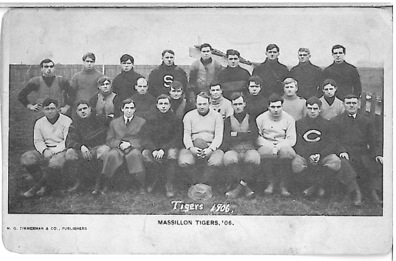
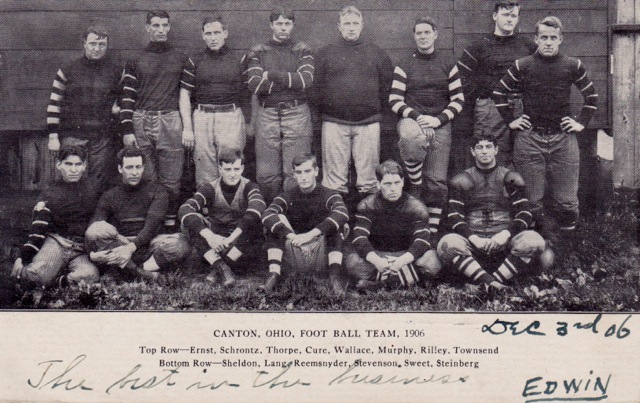
MASSILLON TIGERS 1906 CANTON BULLDOGS 1906
MASSILLON
“The story of how American sports, American media, and American myth were corrupted at birth — and why we’re still paying for it.”
A Historical Series (8 Episodes)
Genre: Historical Drama / True Crime
Tone: Game of Thrones meets Boardwalk Empire with the moral complexity of The Crown. It has elements of Deadwood and The Knick.
LOGLINE
In 1906, as professional football is being born in the industrial heart of Ohio, a scandal between rival towns Canton and Massillon erupts into the first major crisis in American sports history — exposing how ambition, media, and moral certainty collide, and how women are forced to pay the hidden cost of men’s wars.
SERIES OVERVIEW
MASSILLON tells the true story of the Canton–Massillon football scandal of 1906, a moment when professional football nearly destroyed itself before it had the chance to survive. What begins as a bitter athletic rivalry becomes a national reckoning involving fixed games, fabricated evidence, and the weaponization of public opinion.
At the center is Charles Edgar “Blondy” Wallace, a gifted, reckless coach whose reputation is publicly annihilated before he is ever judged. Opposing him is E.J. Stewart, an educator, editor, and moral absolutist who believes truth must be enforced — even if people are destroyed in the process.
But MASSILLON is not only their story.
Running parallel — and ultimately colliding — are the lives of two women trapped inside a system that denies them power while freely using their names, bodies, and silence:
Cassie Chadwick, a sharp, self-made madam whose intimacy with Wallace places her at the center of the scandal. As accusations spiral, Cassie becomes both a witness and a scapegoat — stripped of agency, publicly humiliated, and forced to decide whether truth is worth annihilation in a world that never intended to protect her.
Margaret Stewart, the editor’s wife, begins as a model of restraint and belief in her husband’s righteousness. But as she watches his certainty harden into cruelty, Margaret becomes the series’ moral conscience — quietly recognizing the human cost of “doing the right thing,” and ultimately choosing truth over loyalty.
Their stories expose what the men cannot see: that public honor often survives on private ruin.
The series is narrated by Jack Cusack, the young Canton ball boy who survives the scandal and later helps rebuild professional football in Canton — offering a reflective, hard-earned perspective on how truth, once distorted, leaves permanent scars.
WHY THIS STORY? — WHY NOW?
Although set in 1906, MASSILLON mirrors our present moment with uncanny clarity:
- Trial by headline
• Media influence over justice
• Institutions protecting themselves at all costs
• Women blamed, erased, or sacrificed to preserve male power
• Moral certainty replacing accountability
This is a story about who gets believed, who gets buried, and who gets remembered — and how history is written by those with access to ink, not innocence.
STRUCTURE & FORMAT
The series unfolds over 8 episodes, structured around moral fault lines rather than simple chronology. Public spectacle and private consequence are interwoven — allowing the audience to experience how decisions made in boardrooms, newsrooms, and locker rooms echo inside bedrooms, parlors, and courtrooms.
The finale confronts not just guilt or innocence — but whether truth can survive once institutions decide what they need it to be.
These are the EIGHT Episodes already written:
Episode One – Birth of the Ohio League (Pilot) – 68 pages
Episode Two – Thy Kingdom Come, Thy Will Be Done – 59 pages
Episode Three – Lesson of the Widow’s Mite – 65 pages
Episode Four – Once the Bullet Leaves the Barrel – 53 pages
Episode Five – When Dread Comes Like a Storm – 62 pages
Episode Six – And the Truth Shall Set You Free – 66 pages
Episode Seven – On Hallowed Ground (Penultimate) – 70 pages
Episode Eight – Their Honor Inviolate (Finale) – 90 pages
TONE & AUDIENCE
MASSILLON is a prestige series for adult audiences — emotionally grounded, morally complex, and deeply human. While football is the backdrop, the series is ultimately about power, belief, and consequence, told equally through men who shape history and women who absorb its cost.
This is not a sports series. It is a story about how reputations are built, destroyed, and buried — and who is left standing when the dust settles.
END NOTE:
The NFL exists because men like Jack Cusack chose to rebuild trust after it was shattered. Whether Blondy Wallace was truly guilty remains debated by historians — but the damage done in 1906 is beyond dispute. MASSILLON asks a timeless question:
What is the price of righteousness — and who decides who pays it?
ONE-PARAGRAPH CHARACTER THESIS:
CHARLES “BLONDY” WALLACE
Blondy Wallace is a brilliant, reckless architect of early professional football — a man whose genius for organization and motivation is undermined by his appetite for excess, intimacy, and risk. He believes football belongs to the players and the crowd, not the businessmen who monetize it, and that belief makes him dangerous to those in power. Blondy is not undone by a single crime, but by a lifetime of proximity to temptation and a fatal misunderstanding of loyalty. His tragedy is not corruption, but charisma without caution — a man who inspires devotion yet fails to protect the people who love him, leaving him isolated when the institution he helped build turns on him.
E.J. STEWART
E.J. Stewart is discipline incarnate — a tactician, educator, and moral absolutist who views sport as a civilizing force that must be protected from impurity at all costs. Where Blondy trusts instinct, Stewart trusts systems; where Blondy lives expansively, Stewart lives by restriction. Stewart does not see himself as cruel — he sees himself as necessary. His flaw is not ambition or greed, but conviction without empathy. As the scandal deepens, Stewart crosses the invisible line between guardian and executioner, convinced that destroying one man is acceptable if it preserves the future of the game. His downfall lies in mistaking righteousness for truth.
CASSIE CHADWICK
Cassie Chadwick is a survivor who understands power because she has lived beneath it. Intelligent, observant, and emotionally disciplined, she navigates a world where women are currency and discretion is survival. Her relationship with Blondy offers intimacy without protection — affection without legitimacy — and when scandal erupts, Cassie becomes expendable evidence in a war she never chose. Her arc is the most devastating: a woman who tells the truth in a society that punishes her for speaking it. Cassie embodies the human cost of public spectacle — proof that moral crusades rarely distinguish between the guilty and the vulnerable.
MARGARET STEWART
Margaret Stewart begins as a believer — educated, composed, and committed to her husband’s sense of order and moral purpose. As events unfold, she becomes the series’ quiet moral witness, recognizing that certainty can be as destructive as corruption. Margaret’s journey is not rebellion but awakening. She sees that integrity without compassion becomes violence by another name. While Stewart tightens his grip on righteousness, Margaret loosens hers, ultimately choosing truth over loyalty. She represents the cost of standing beside power — and the courage required to step away from it.
SCREENWRITER’S COMMENTARY:
I came to Massillon through football history, but I stayed because of the people it broke.
In 1906, professional football nearly collapsed under the weight of its first great scandal — accusations of fixed games, forged contracts, and reputations destroyed long before any court weighed evidence. What fascinated me was not whether Charles “Blondy” Wallace was guilty or innocent, but how quickly powerful men decided the truth — and how permanent that decision became.
At its core, Massillon is a story about two men who love the same institution for very different reasons — and are willing to destroy it to save it.
Charles Edgar “Blondy” Wallace is charisma, excess and contradiction. A brilliant organizer and motivator who believes the game belongs to the players and the crowd — not the men who profit from it. He lives recklessly, trusts too easily, and mistakes proximity for loyalty. Blondy is not innocent in the way saints are innocent; he is innocent in the way men are — flawed, indulgent, and blind to the damage they leave behind.
E.J. Stewart is discipline, control, certainty. A man who believes sport is a moral instrument — one that must be purified at any cost. Stewart does not act out of greed; he acts out of conviction. His tragedy is not corruption, but righteousness without mercy. He becomes convinced that destroying one man is acceptable if it preserves the game’s future.
These two men are not enemies by nature. They are mirrors — each convinced the other represents everything that will ruin football.
Between them stand two women history tried to forget.
Cassie Chadwick understands power because she has survived beneath it. She sees how quickly men turn intimacy into evidence and how easily a woman becomes collateral in a war she never chose. Cassie’s tragedy is not her profession — it is believing that love might grant her protection in a world that has none to offer.
Margaret Stewart begins as a believer. Educated, composed, and loyal to her husband’s mission, she slowly realizes that moral certainty can be as destructive as corruption. Margaret’s journey is not rebellion — it is awakening. She becomes the series’ quiet conscience, watching as conviction erases compassion and truth becomes a weapon.
Together, these four characters form the emotional engine of Massillon.
This is not a story about heroes and villains — it is about people convinced they are right, and the cost of that conviction.
Structurally, Massillon is designed as an eight-episode series, moving fluidly between public spectacle and private reckoning — courtrooms and locker rooms, newspaper offices and bedrooms. The series resists easy answers, allowing contradiction to live on the screen rather than be resolved by narration.
The story is framed by Jack Cusack, coach of the Canton Bulldogs from 1912-1918 who witnessed the scandal and later through his discovery and development of the greatest athlete of the century, Jim Thorpe, helps rebuild professional football and the formation of the NFL. His voice is reflective, not authoritative — a man shaped by what he saw and haunted by what was lost.
I was not interested in delivering verdicts. I was interested in examining how institutions manufacture truth, how media sanctifies narrative, and how quickly public trust becomes irreversible judgment.
MASSILLON is about the stories we tell to justify ourselves — and the people those stories consume.
I see this as a collaborative project with a showrunner drawn to moral ambiguity, historical texture, and character-driven tragedy. This is a series that trusts its audience and demands restraint from its creators.
If football became America’s first mass religion, Massillon is its original schism. And the echoes are still with us.
“Massillon” IS the greatest sports story never told.
Richard A. “Rick” Cohen